Valid Names Results
Heliococcus summervillei Brookes, 1978 (Pseudococcidae: Heliococcus)Nomenclatural History
- Heliococcus summervillei Brookes 1978: 241. Type data: Holotype: AUSTRALIA: Queensland, on Paspalum dilatatum, and paratype females, PAKISTAN: Peshawar, on Saccharum officinarum. Holotype, female, Type depository: Canberra: Australian National Insect Collection, CSIRO Entomology, Australia; accepted valid name Illustr.
- Novonilacoccus oryzae Ghosh & Ghose 1987: 5. Type data: INDIA: West Bengal, Kalyani, on Oryza sativa. Holotype, female, Type depository: Kalyani: Department of Agricultural Entomology, Bihan Chandra Krishi Viswavidyalaya, West Bengal, India; junior synonym (discovered by Willia2004a, 349). Illustr.
Common Names
- old pasture mealybug PowellMiLa2026a
Ecological Associates
Hosts:
Families: 2 | Genera: 15
- Cyperaceae
- Eleocharis | BrinonMaCh2004
- Poaceae
- Axonopus compressus | BrinonMaCh2004 | (= Paspalum compressum)
- Brachiaria decumbens | MilleHeCa2016
- Brachiaria ruziziensis | BrinonMaCh2004
- Chloris gayana | BrinonMaCh2004 | ssp. callide)
- Digitaria milanjiana | BrinonMaCh2004
- Hemarthria altissima | PowellHa2026a
- Megathyrsus maximus | PowellMiLa2026a
- Ochthochloa compressa | BrinonMaCh2004 | (= Panicum compressum)
- Oryza sativa | BenDov1994 GhoshGh1987 Varshn1992
- Panicum maximum | BrinonMaCh2004
- Paspalum | Summer1928
- Paspalum dilatatum | BenDov1994 Willia1985
- Paspalum setaceum | PowellMiLa2026a
- Rottboellia cochinchinensis | AcaMarGoHe2025
- Saccharum officinarum | BenDov1994 Brooke1978
- Sorghum halepense | AcaMarGoHe2025
- Urochloa mosambicensis | BrinonMaCh2004
Foes:
Families: 2 | Genera: 4
- Coccinellidae
- Cryptolaemus montrouzieri | Summer1928
- Encyrtidae
- Callipteroma sexguttata | Summer1928 | (= Leptomastix guttatipennis)
- Parectromoidella | Hauxwe2022
- Yasumatsuiola orientalis | PowellHa2026
Geographic Distribution
Countries: 9
- Australia
- Queensland | BenDov1994 Brooke1978 Summer1928
- Barbados | PowellHa2026
- India
- West Bengal | BenDov1994 GhoshGh1987 Varshn1992 Willia2004a
- Mexico
- Quintana Roo | AcaMarGoHe2025
- New Caledonia | BrinonMaCh2004
- Pakistan | BenDov1994 Brooke1978 Willia2004a
- Puerto Rico & Vieques Island
- Puerto Rico | PowellHa2026
- U.S. Virgin Islands | PowellMiLa2026a
- United States
- Florida | PowellHa2026a
- Louisiana | Blanch2026
- Texas | BilesSeSa2025
Keys
- PowellMiLa2026a: pp.23 ( Adult (F) ) [Heliococcus with crateriform aggregations]
- Willia2004a: pp.343 ( Adult (F) ) [Heliococcus species of southern Asia]
- Tang1992: pp.458 ( Adult (F) ) [Palaearctic & Oriental regions]
Remarks
- Systematics: urn:lsid:zoobank.org:act:8132324A-6D80-4A0E-889C-1C0229A15D4D
Once slide-mounted, Heliococcus Šulc has a unique type of crateriform tubular duct that makes it difficult to confuse with any other genus of mealybug . Slide-mounted characters and illustrations of H. summervillei are given in detail by Brookes (1978). A comparison of the old pasture mealybug, H. summervillei, and the new pasture mealybug, H. novovillei, is detailed in Powell, et al., 2026a.
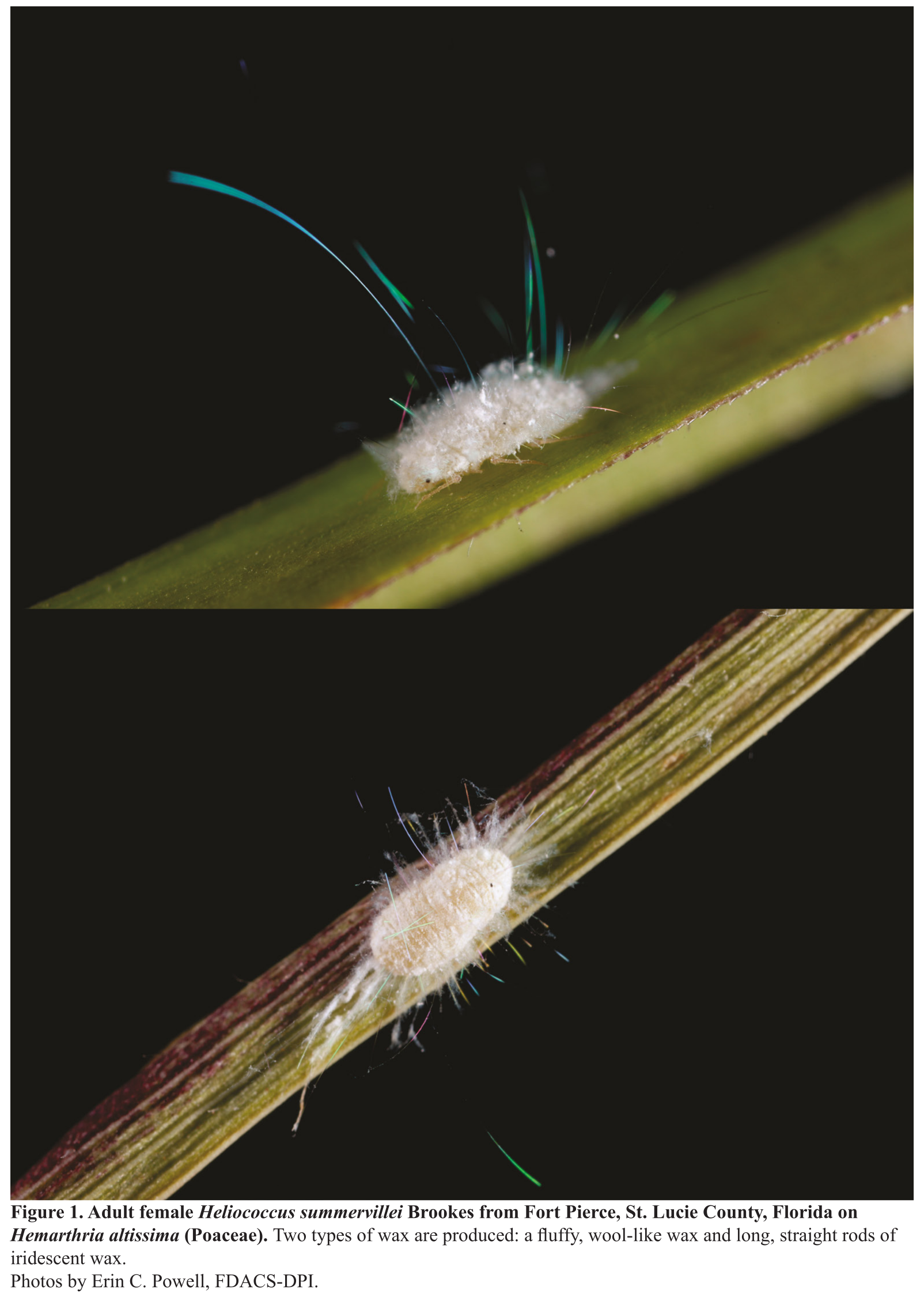
- Structure: Adult females of H. summervillei are about 2–4 mm in body length, while the tiny crawlers (the first-instar nymph mobile dispersal stage) are less than 0.5 mm in length. Immature (nymph) and unmated female mealybugs are a creamy-white color, with adult females turning pink after mating (Hauxwell, 2018; Hauxwell et al., 2022a). Males turn pink ahead of pupation and are pink in their winged adult form. (Powell & Hauxwell, 2026) Adult females cream-white in color, turning pink at maturity. With three distinct types of wax: a loose fluff of opaque wax arising from quinquelocular pores, straight iridescent rods arising from large crateriform ducts, these surrounded by more loose fluff produced by small crateriform ducts, and dense wax filaments arising from the cerarian setae on the anal lobe. In life, the wax rods arising from the crateriform aggregations (especially those in the dorsomedial areas) may look “fluffier” with less light refraction and thus they create less of an iridescent rainbow effect in H. summervillei compared with H. novovillei. This owes to the higher number of small crateriform ducts surrounding the large crateriform duct in these areas. When small crateriform ducts are fully replaced by quinquelocular pores in H. novovillei, no opaque wax surrounds the long rods. However, we stress that small crateriform number (and thus wax production) is variable, wax is easily broken or rubbed of, and field observations of wax should not be relied upon for separation of these two species. Study of slide-mounted specimens is required. (Powell, et al. 2026a)
- Biology: Heavy infestations were observed on leaves of the host (Ghosh & Ghose, 1987). Mature female mealybugs and pupae of males were mainly found in the crown and dense thatch layers of grasses during the warmer, wetter conditions of late summer January to March) in both years. Mealybugs in the field appear to mate and females produce young in the protection of the dense crown and thatch layer of grasses in mid to late summer.. (Hauxwell, 2022)
- Economic Importance: Summerville (1928) first reported on this species as "mealy bug" and presented observations on its economic importance, life history, control and natural enemies. Brinon et al. (2004) recorded this species from New Caledonia, reporting of severe damage to pasture grasses from 1998 to 2003. In 2003 the pest populations were almost completely reduced, probably due to unexplained natural causes. In Texas, it has been noted on and damaging Bermudagrass, Bahia grass, Johnsongrass, hay grazer (Sorghum-sudangrass), several bluestem species, and St. Augustine turfgrass. (Biles, et al. 2026a)
- General Remarks: Description and illustration of adult female by Brookes (1978), Ghosh & Ghose (1987) [as Novonilacoccus oryzae] and by Williams (2004a). Description and illustration of first-instar nymph, second-instar female nymph and third-instar female nymph given by Ghosh & Ghose (1987) [as Novonilacoccus oryzae]. Description and illustration of adult male by Ghosh & Ghose (1989) [as Novonilacoccus oryzae]. Detailed redescription, photographs and illustration in Powell, et al., 2026b)
Illustrations


Citations
- AcaMarGoHe2025: chemical control, diagnosis, distribution, economic importance, host, illustration, natural enemies, record,
- AhmedPoMi2025: dispersal, 10
- BenDov1994: catalog, 38-39, 188
- BilesSeSa2025: control, diagnosis, distribution, host, illustration, record,
- BilesSeSa2026a: control, diagnosis, distribution, host, illustration,
- Blanch2026: distribution, economic importance, host, illustration, record,
- BrinonMaCh2004: distribution, economic importance, host, life history, 425-428
- Brooke1978: description, distribution, host, illustration, taxonomy, 241, 242, 244
- GhoshGh1987: description, distribution, host, illustration, taxonomy, 39-48
- Hauxwe2018: biology, control, economic importance, illustration, natural enemies,
- Hauxwe2022: biology, control, economic importance, natural enemies,
- HauxweDiBr2022: control, diagnosis, endosymbiont, life history, molecular biology, natural enemies, phylogeny,
- KondoWa2022a: distribution, host, list, 23
- MilleHeCa2016: distribution, host, 149
- PhilliBaBe2026: distribution, economic importance, host, 4
- PowellHa2026: biology, distribution, economic importance, host, natural enemies, record,
- PowellHa2026a: biology, distribution, economic importance, host, natural enemies, record,
- PowellMiLa2026a: description, distribution, host, illustration, key, taxonomy, 17-22
- SchneiPo2026: distribution, economic importance, list, 26
- SchutzGoGu2026: distribution, morphology, taxonomy, 22-23
- SchutzTrHa2019: dispersal, distribution, history, host, importance,
- Summer1928: biological control, distribution, economic importance, host, life history, 201-209
- Tang1992: description, distribution, host, taxonomy, 486
- Varshn1992: distribution, host, 43
- VercheSaEs2025: behavior, 11
- Willia1985: distribution, host, taxonomy, 172
- Willia2004a: description, distribution, host, illustration, taxonomy, 348-350
- XuHuWi2024: control, host plant,