Valid Names Results
Heliococcus novovillei Powell & Miller, 2026 (Pseudococcidae: Heliococcus)Nomenclatural History
-
Heliococcus novovillei
Powell & Miller
2026: 1.
Type data: USA: Florida, Hendry Co., Pioneer, on Saccharum, 6/5/2026, by C. Powell & D.J. Miller. Holotype, female, by original designation
Type depository:
Gainesville: Florida State Collection of Arthropods, Division of Plant Industry, Florida, USA;
accepted valid name
Notes: urn:lsid:zoobank.org:pub:48A8110E-08BE-45E9-BF63-20844AF08BC6
Paratypes: 149 adult ♀♀, 4 adult ♂♂, 12 3rd instar ♀♀, 12 2nd instar, 11 1st instar paratypes on 184 slides Australian National Insect Collection, CSIRO Entomology, Canberra, Australia, Florida State Collection of Arthropods, Gainesville, Florida, U.S.A, California State Collection of Arthropods, Sacramento, California, U.S.A., Louisiana State Arthropod Museum, Baton Rouge, Louisiana, U.S.A. North Carolina State University, Raleigh, North Carolina, U.S.A, Natural History Museum, London, U.K. Texas A&M University Insect Collection, College Station, Texas, U.S.A. University of California, Davis, California, U.S.A. Illustr.
Common Names
- New pasture mealybug
Ecological Associates
Hosts:
Families: 1 | Genera: 14
- Poaceae
- Bothriochloa | PowellMiLa2026a
- Bothriochloa ischaemum | PowellMiLa2026a
- Cenchrus echinatus | PowellMiLa2026a
- Cynodon aethiopicus | PowellMiLa2026a
- Digitaria bicornis | PowellMiLa2026a
- Digitaria ciliaris | PowellMiLa2026a
- Digitaria eriantha | PowellMiLa2026a
- Digitaria longiflora | PowellMiLa2026a
- Eleusine indica | PowellMiLa2026a
- Eustachys | PowellMiLa2026a
- Hemarthria altissima | PowellMiLa2026a
- Imperata cylindrica | PowellMiLa2026a
- Megathyrsus maximus | PowellMiLa2026a
- Panicum hemitomon | PowellMiLa2026a
- Paspalum notatum | PowellMiLa2026a
- Paspalum setaceum | PowellMiLa2026a
- Saccharum |
- Saccharum officinarum | PowellMiLa2026a PowellMiLa2026a
- Sorghum bicolor | PowellMiLa2026a
- Sorghum halepense | PowellMiLa2026a
- Sporobolus pyramidalis | PowellMiLa2026a | (= Sporobolus jacquemontii)
Geographic Distribution
Countries: 3
- Australia | PowellMiLa2026a
- Mexico
- Quintana Roo | PowellMiLa2026a
- United States
- Florida | PowellMiLa2026a
- Louisiana | PowellMiLa2026a
- Texas | PowellMiLa2026a
Keys
- PowellMiLa2026a: pp.23 ( Adult (F) ) [Heliococcus with crateriform aggregations]
Remarks
- Systematics: urn:lsid:zoobank.org:pub:48A8110E-08BE-45E9-BF63-20844AF08BC6
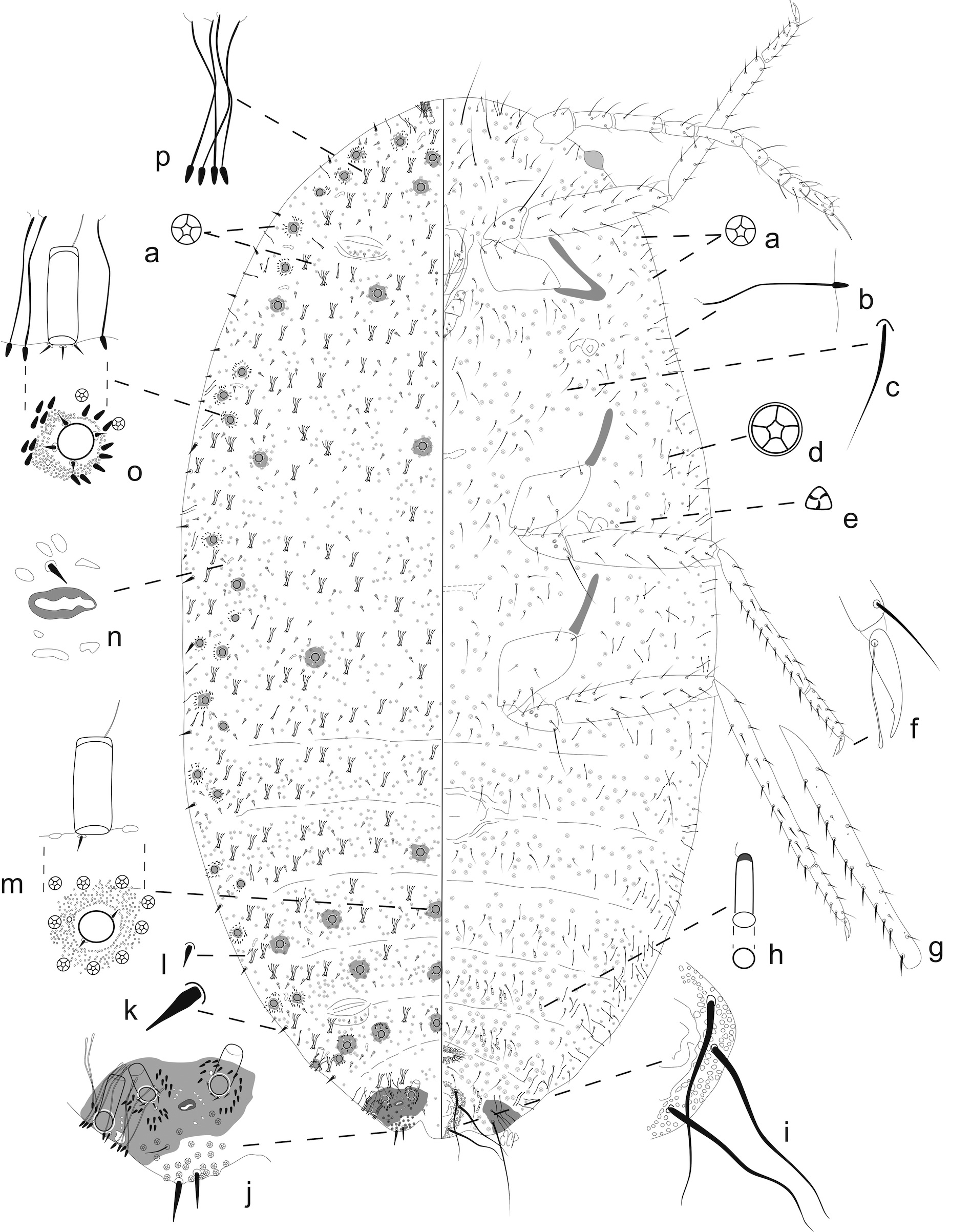
Heliococcus novovillei is similar to H. summervillei in having crateriform aggregations, each with a central large crateriform duct and associated small crateriform ducts; quinquelocular pores abundant on ventral and dorsal surfaces; a circulus; and no multilocular pores. However, H. novovillei differs from H. summervillei as follows (character states of H. summervillei are given in parentheses): (i) each anal lobe cerarius usually with 2, rarely 3, conical setae (with 8 to 15 conical setae in each anal-lobe cerarius); (ii) translucent pores on hind tibia small and inconspicuous, each pore smaller than a leg setal base (large and conspicuous, each pore larger than a leg setal base); (iii) some large-sized crateriform ducts in medial area of dorsum without many associated smallsized crateriform ducts, these either reduced in number or entirely replaced by a circle of quinquelocular pores (large-sized crateriform ducts in medial area of dorsum each surrounded by many (usually more than 10) smallsized crateriform ducts, quinqueloculars not specifcally associated with clusters); and (iv) ventral quinquelocular pores in the medial areas of anterior abdominal segments, thorax, and head each with a sclerotized rim, distinctly larger than those on ventral margin and those on the dorsum (ventral quinquelocular pores in the medial areas of anterior abdominal segments, thorax, and head without a rim, each about the same size as those on the dorsum). Heliococcus novovillei is also similar to H. clemente Miller in having crateriform aggregations, quinquelocular pores, a circulus, and no multilocular pores. However, H. novovillei difers from H. clemente as follows (character states of H. clemente are given in parentheses): (i) dorsum with numerous quinquelocular pores and no trilocular pores (dorsum with no quinquelocular pores and numerous trilocular pores); (ii) with cerarii restricted to anal-lobe pair (minal segments); and (iii) large-sized crateriform cerarii present on posterior three or four abdominal ducts not projecting above dermal surface (large-sized crateriform ducts projecting above dermal surface). (Powell, et al. 2026a)
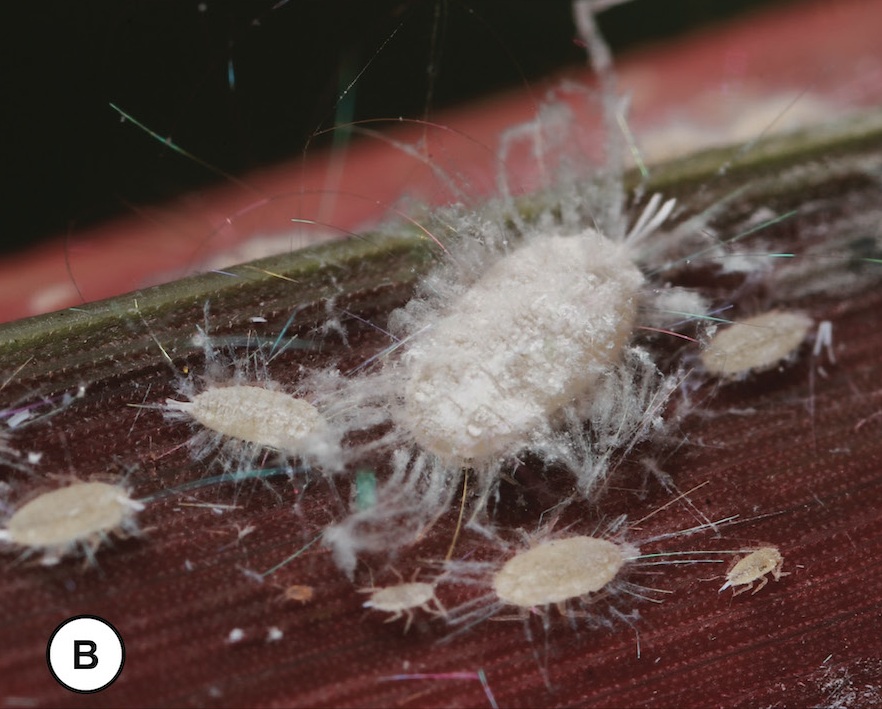
- Structure: Adult females and nymphs cream-white in color, mature adult females turning pink. With three distinct types of wax: a loose fuf of opaque wax arising from quinquelocular pores, straight iridescent rods arising from large crateriform ducts, and dense wax flaments arising from the cerarian setae on the anal lobe. Adult male pink-bodied and covered in a dusting of white wax, with one pair of wax tails. (Powell, et al. 2026b) Slide-mounted adult ♀ holotype 2.26 mm long, 1.26 mm wide; paratypes (n=10 measured, 155 total examined) 1.31−2.84 mm long, 0.6−1.72 mm wide; body elongate oval. (Powell, et al. 2026a)
- Economic Importance: The new pasture mealybug, Heliococcus novovillei has caused major pasture dieback and “yellow canopy syndrome” in Australia for over a decade and, as of at least 2025, is causing major damage to pasture grass and sugarcane in the southern United States (Florida, Louisiana, Texas) and Mexico. It is now at outbreak infestation levels in Australia and the United States. (Powell, et al. 2026a)
- General Remarks: Detailed detailed description, photographs and illustrations in Powell, et al. 2026b
Illustrations
Citations
- PowellMiLa2026a: description, diagnosis, distribution, economic importance, host, illustration, key, molecular data, 1-27